Galgo Espanol
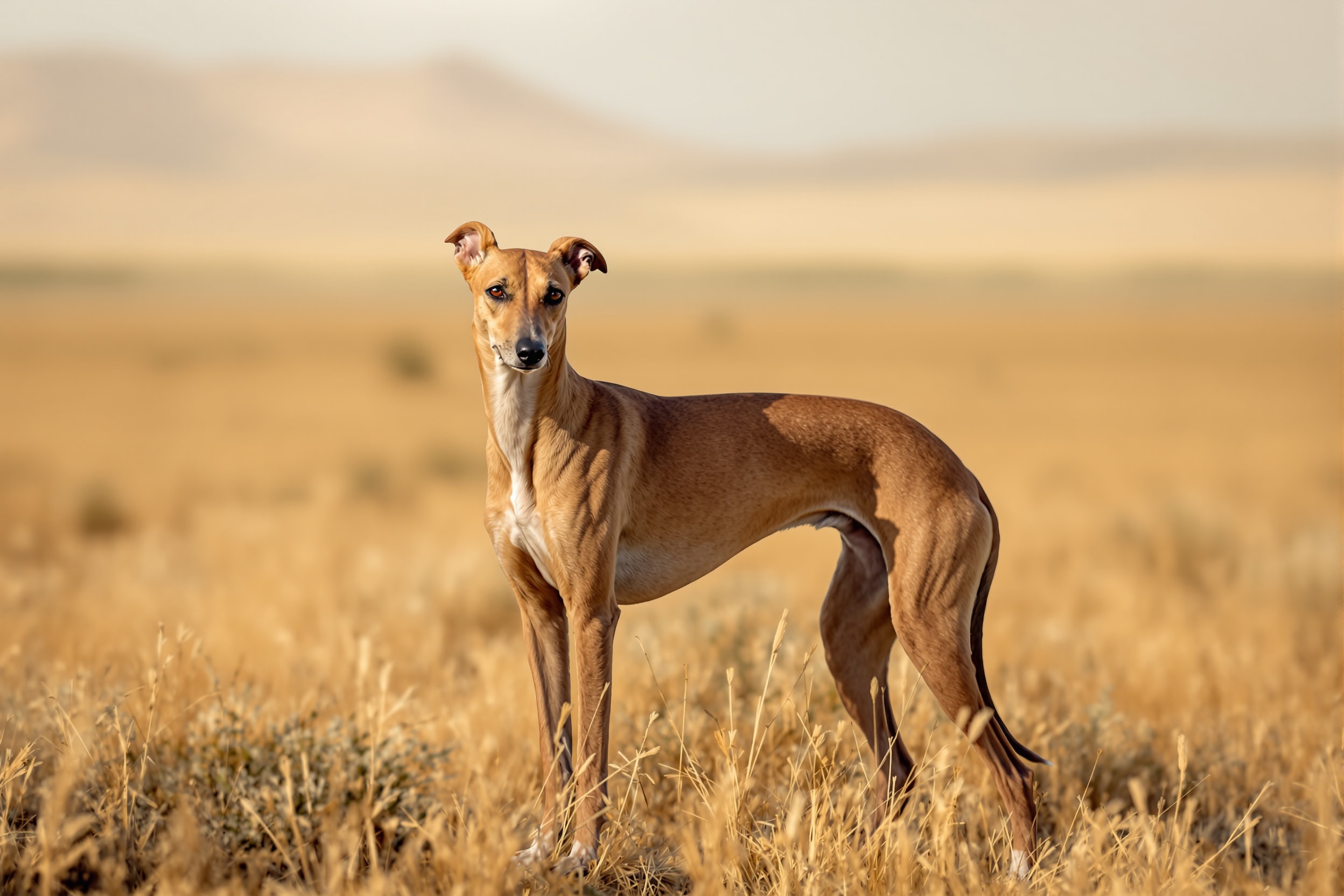
- Country
- Spain
- Height
- 24.5-27.5 inches (62-70 cm) dogs; 23-26 inches (60-68 cm) bitches
- Weight
- 44-66 pounds (20-30 kg)
- Coat
- Short and smooth, or rough and wiry (both varieties permitted)
- Colour
- Any; brindle, fawn, black, cinnamon, toasted and white all common
- Other Names
- Spanish Greyhound, Galgo
- Registry
- FCI Group 10, standard no. 285; not AKC recognised
- Group
- Sighthound
The Galgo is the sighthound of the Spanish plains — older than the Greyhound it is constantly compared to, built for a different kind of ground, and at the centre of one of the most persistent animal welfare problems in Europe.
Not a Greyhound
The two breeds are related and the confusion is understandable, but they are not the same dog and were not built for the same job.
The Greyhound was refined for the short explosive sprint of the coursing field and the track. The Galgo was bred to run hares across open Spanish country — longer distances, rougher ground, more turning, and much more of it. The consequences are visible: the Galgo is longer in the body relative to its height, less extreme in the chest and tuck-up, longer in the tail, and built for stamina at high speed rather than maximum acceleration. It is generally the slower of the two over a short course and far the better over a long one.
There is also a rough-coated variety, the galgo barcino or wire-haired Galgo, with no Greyhound equivalent.
Origins
Sighthounds have been present in Iberia for a very long time, and the Galgo's ancestry is usually traced to hounds arriving with Roman and later North African contact, developed thereafter as a distinctly Spanish type. The name itself derives from canis gallicus, the Gaulish dog, pointing to a Roman-era route.
Whatever the exact path, the breed was well established by the medieval period, when it appears in Spanish hunting literature and law. Coursing with galgos was a noble sport before it was a rural one, and it later became deeply embedded in the agricultural life of Castile, Extremadura and Andalusia — which is where its modern difficulties begin.
Temperament
Galgos surprise people. Like most sighthounds they are quiet, gentle, undemanding and startlingly lazy indoors — a breed capable of extraordinary athletic effort and content to spend twenty hours a day asleep on something soft.
They are affectionate and notably sensitive, responding poorly to harsh correction. They are also, without exception, dogs with a strong prey drive that should not be trusted off-lead in unsecured space, and they need a properly fenced area to run. They tolerate other dogs well, tend to be reserved rather than fearful with strangers, and are quiet in the house.
Welfare
An honest entry cannot leave this out. Very large numbers of galgos are bred each year in Spain for hare coursing, and large numbers are abandoned or destroyed at the end of the season when they are judged too slow, too old or surplus. The scale has been documented repeatedly by Spanish and international animal welfare organisations, and it has produced a substantial rescue and adoption network across Spain, the Netherlands, Germany, Belgium and increasingly the United Kingdom and North America.
The practical consequence for anyone drawn to the breed is that adoption is the normal route to owning one, and rescued galgos are frequently available in numbers that far exceed demand. General guidance on the process is under adopting a dog. Reputable rescues assess temperament and are candid about individual dogs; ex-coursing galgos vary widely in their experience of domestic life and some need patient rehabilitation.
Health and Care
Galgos are a healthy breed with few inherited conditions, in part because they have never been heavily selected for appearance. The important practical points are those common to all sighthounds: very low body fat means poor cold tolerance and a need for bedding and a coat in winter; the same lack of fat makes them sensitive to certain anaesthetic agents, and any veterinary surgeon should be told the dog is a sighthound before sedation. Thin skin tears easily. Dental care matters more than average.
Exercise needs are lower than most people expect — a couple of daily walks and regular access to a secure space to sprint. See exercise and the health guide. Related sighthounds, including the Sloughi and the Azawakh, appear in the breeds list.