Regular Dog Grooming
Grooming advice usually fails because it is given generically. What a dog's coat needs depends almost entirely on what kind of coat it is, and the right routine for one type actively damages another.
Know Your Coat Type
Double coats
A harsh outer jacket over a dense woolly undercoat — the northern and many working breeds, including the Karelian Bear Dog, the Lundehund and the Saarlooswolfhond.
These coats moult heavily twice a year, when the undercoat comes out in sheets. The routine is regular brushing year-round and daily attention during the moult, using an undercoat rake or slicker that reaches through to the dense layer.
Do not clip a double coat. This is the single most common and most damaging grooming error. The outer coat insulates against heat as well as cold and protects against sun; clipping it removes that protection, and the guard hairs frequently grow back thin, soft and patchy. A shaved northern dog is hotter, not cooler, and more exposed to sunburn. If the dog is struggling in heat, the answer is shade, water and thorough de-shedding — never a clipper.
Wire coats
Harsh, crisp coats on the terriers and many gundogs — the Scottish Terrier among them. These are traditionally hand-stripped, meaning the dead outer hairs are plucked out by hand or with a stripping knife, allowing new harsh hair to grow.
Clipping a wire coat cuts the hairs rather than removing them, and over time produces a soft, faded coat that has lost both its texture and its weather resistance. Many pet owners accept this trade for convenience; it is a legitimate choice as long as it is a choice rather than an accident.
Curly and woolly coats
The water dogs and poodles — the Barbet is the type specimen. These coats shed very little, which is why they are often described as low-maintenance, and the description is precisely backwards: hair that does not shed stays in the coat and mats.
They need thorough brushing right down to the skin several times a week and professional clipping every six to eight weeks. Surface brushing that leaves a mat at the skin is worse than none, because it hides the problem.
Long silky coats
The Shih Tzu and similar. Daily brushing if the coat is kept long, with particular attention behind the ears, under the legs and around the rear. Most pet owners sensibly keep these breeds in a shorter trim.
Smooth coats
The Bullmastiff, the Galgo, the Blue Lacy. A weekly going-over with a rubber curry or hound glove is genuinely all that is needed. Note that smooth does not mean non-shedding.
Bathing
Most dogs are bathed far too often. Frequent washing strips the coat's natural oils and causes the dry, itchy skin it was meant to fix. Unless a dog is actually dirty or has a veterinary reason, every couple of months is ample, and many working coats need less.
Use a dog shampoo — canine skin has a different pH from human skin — brush the coat thoroughly before wetting it, since water tightens existing mats into something that must be cut out, and dry a double coat properly to the skin.
Ears, Nails, Teeth
- Ears. Drop-eared and water breeds need routine checking and thorough drying after swimming. Look for redness, odour or head-shaking, and see a veterinary surgeon rather than pouring anything in on spec.
- Nails. If you can hear them clicking on a hard floor they are too long. Overlong nails alter the foot's posture and cause real discomfort. Trim little and often; the quick recedes as the nail shortens.
- Teeth. The most neglected item and one of the most consequential. Periodontal disease is extremely common in dogs and small breeds are worst affected. Daily brushing with a canine toothpaste is the only thing that genuinely works.
Before You Begin
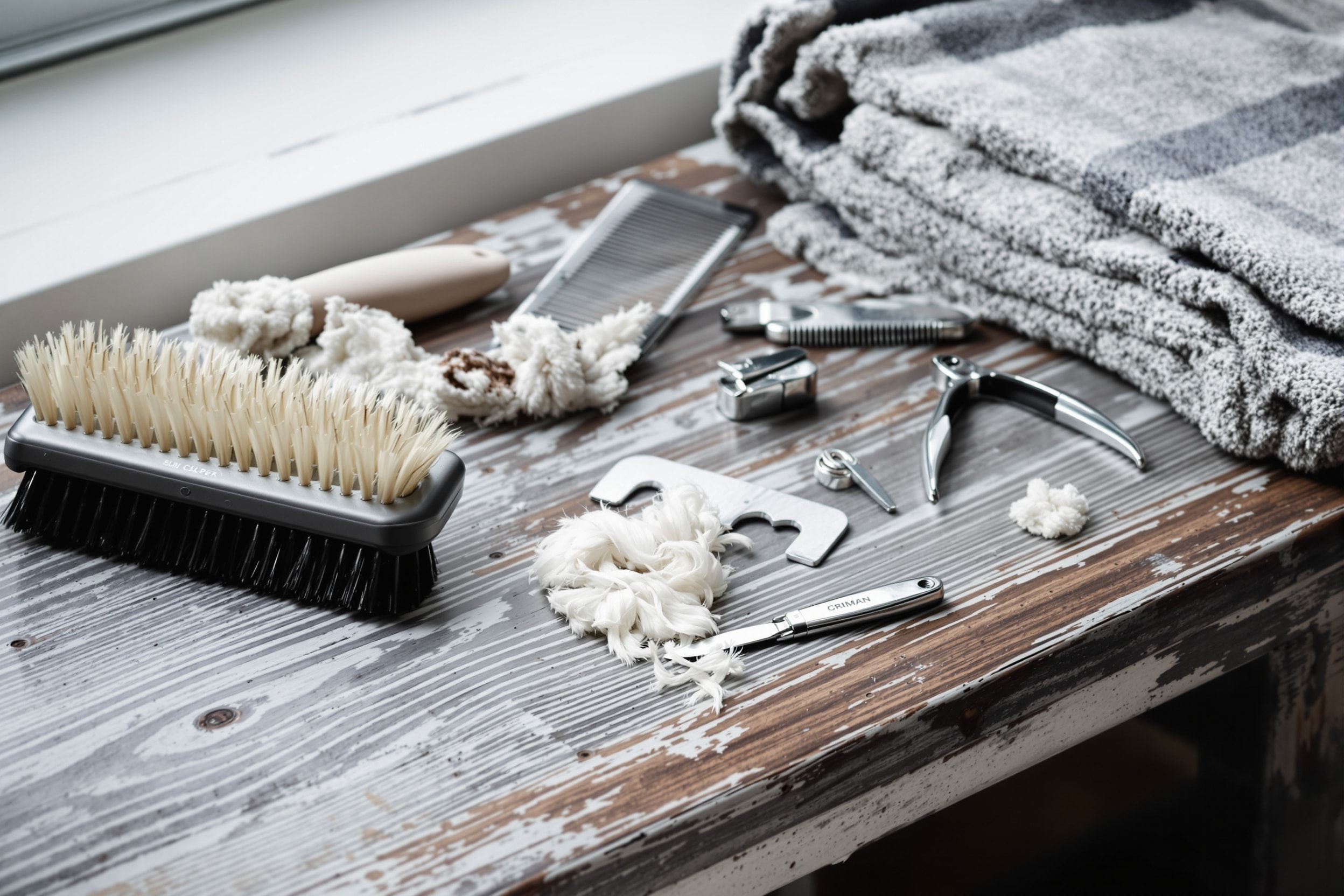
Choose a quiet, well-lit place and set out the tools before bringing the dog over. Check that the brush has no broken pins and use a surface where the dog can stand without sliding. Work on a small area, then pause; pulling away, turning towards the brush or becoming tense is a reason to stop and reassess the session. Ask a groomer to demonstrate the tools appropriate to this particular coat instead of trying every brush in the cupboard. Leave tightly matted hair for professional attention rather than pulling harder or reaching for scissors. If handling reveals sore skin, a lump or an unfamiliar change, ask a vet. Note where it is so that you can describe the same place accurately.
Making It Easy
Start young, keep sessions short, handle feet and ears routinely so they are unremarkable, and stop before the dog has had enough rather than after. A dog that has learned grooming is uneventful will accept it for life. General welfare guidance is published by the American Veterinary Medical Association.