Bullmastiff
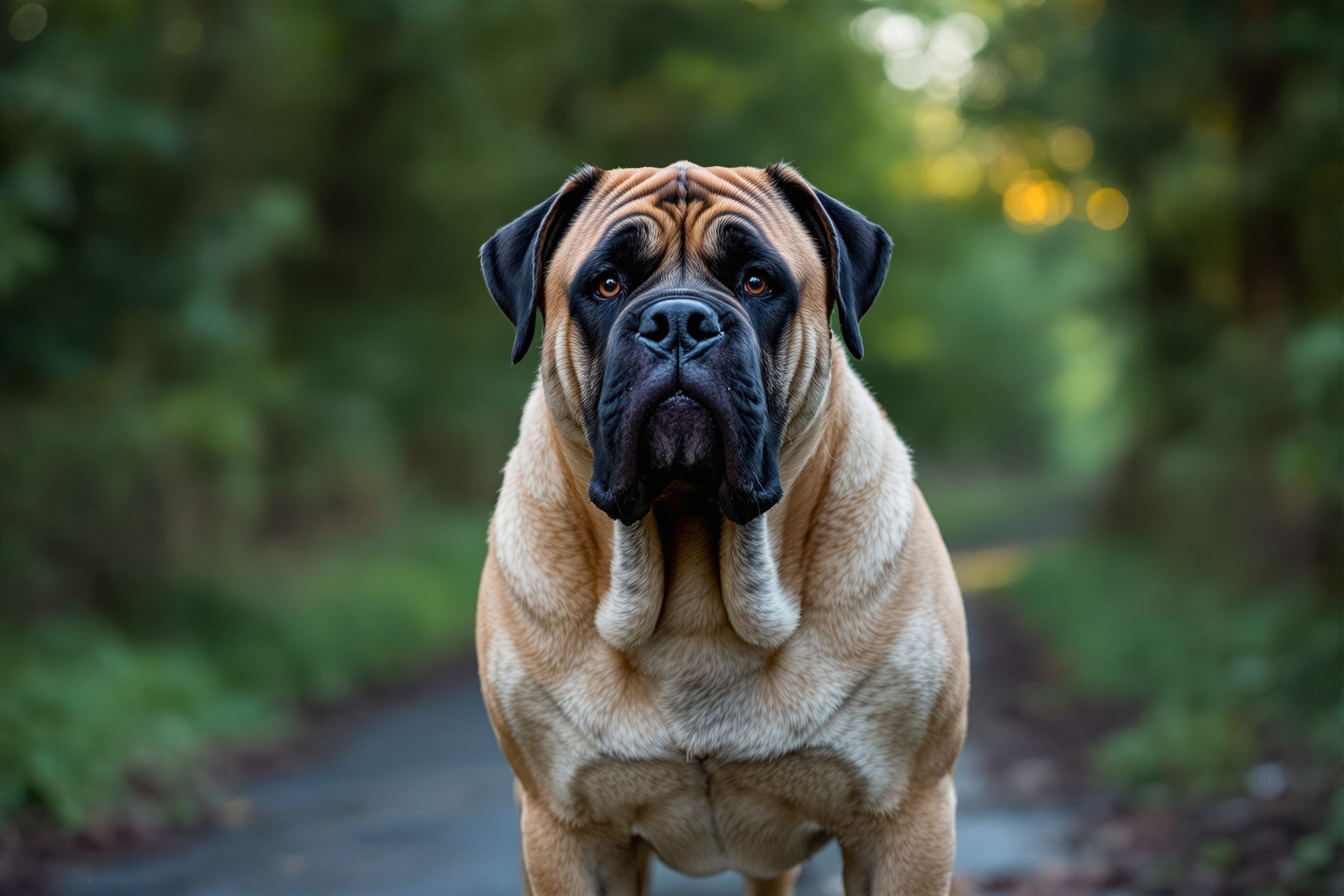
- Country
- England
- Height
- 24-27 inches (61-69 cm)
- Weight
- 100-130 pounds (45-59 kg)
- Coat
- Short, hard and dense
- Colour
- Fawn, red or brindle, always with a black mask
- Other Names
- Gamekeeper's Night Dog
- Registry
- The Kennel Club (1924); AKC (1933); FCI Group 2
- Group
- Working / Molossoid
Most breeds were shaped gradually by a job. The Bullmastiff was designed for one, deliberately and quite recently, and the design brief survives clearly enough that you can read it off the finished dog.
The Brief
In nineteenth-century England the great estates had a poaching problem, and poaching was a capital or transportable offence — which meant a cornered poacher had every reason to fight. Gamekeepers patrolling large woodland at night needed a dog that could do a very particular sequence of things.
It had to be fast enough to run a man down over broken ground. Big and heavy enough to knock him off his feet and pin him. Dark enough to be invisible in a night wood. Quiet enough to arrive without warning. And — this is the part that shaped the temperament — it had to hold the man there without mauling him, because a keeper wanted a prisoner rather than a corpse and an injured poacher was a legal complication.
No existing breed did all of that. The Mastiff had the size but not the speed or drive; the old Bulldog had the tenacity but not the reach. So keepers crossed them, and the working rule of thumb that came down was roughly sixty per cent Mastiff to forty per cent Bulldog.
Why the Early Dogs Were Brindle
The earliest Bullmastiffs were overwhelmingly dark brindle, and for a strictly practical reason: brindle is the best camouflage there is in a night wood. Fawn dogs existed but were less useful to a keeper, showing up against undergrowth in moonlight.
Once the breed moved from the estate into the show ring the priority inverted, and fawn — which displays the black mask to better effect — became the fashionable colour. The shift is a neat illustration of what happens to a working breed when the work stops.
Recognition
The Bullmastiff was recognised by The Kennel Club in 1924 and by the American Kennel Club in 1933, by which time the poaching problem that created it had largely evaporated. It made the transition to companion dog more successfully than most guardian breeds, which says something about how carefully its temperament had been selected in the first place.
Character
The Bullmastiff is calm, quiet and deeply attached to its family, with an alertness that never quite switches off. It is not a barker — silence was part of the specification — and a Bullmastiff that does raise its voice is worth paying attention to.
Two things deserve emphasis for anyone considering one. First, this is a genuinely large and powerful dog whose instinct is to interpose itself, and early, consistent socialisation is not optional. Second, Bullmastiffs are much less energetic than their build suggests — a couple of decent walks suit them far better than endurance work, and puppies in particular must not be over-exercised while their joints are developing.
Health and Lifespan
Like most giant breeds the Bullmastiff is not long-lived, typically reaching seven to nine years. The principal concerns are hip and elbow dysplasia, gastric dilatation-volvulus (bloat), certain cancers including lymphoma, and the heat intolerance that comes with a shortened muzzle. Bloat in particular is an emergency requiring immediate veterinary attention, and any owner of a deep-chested breed should know the signs before they need them.
Responsible breeders screen for hip and elbow scores. General guidance is in the health guide, and related molosser breeds appear under breed groups.