Golden Retriever
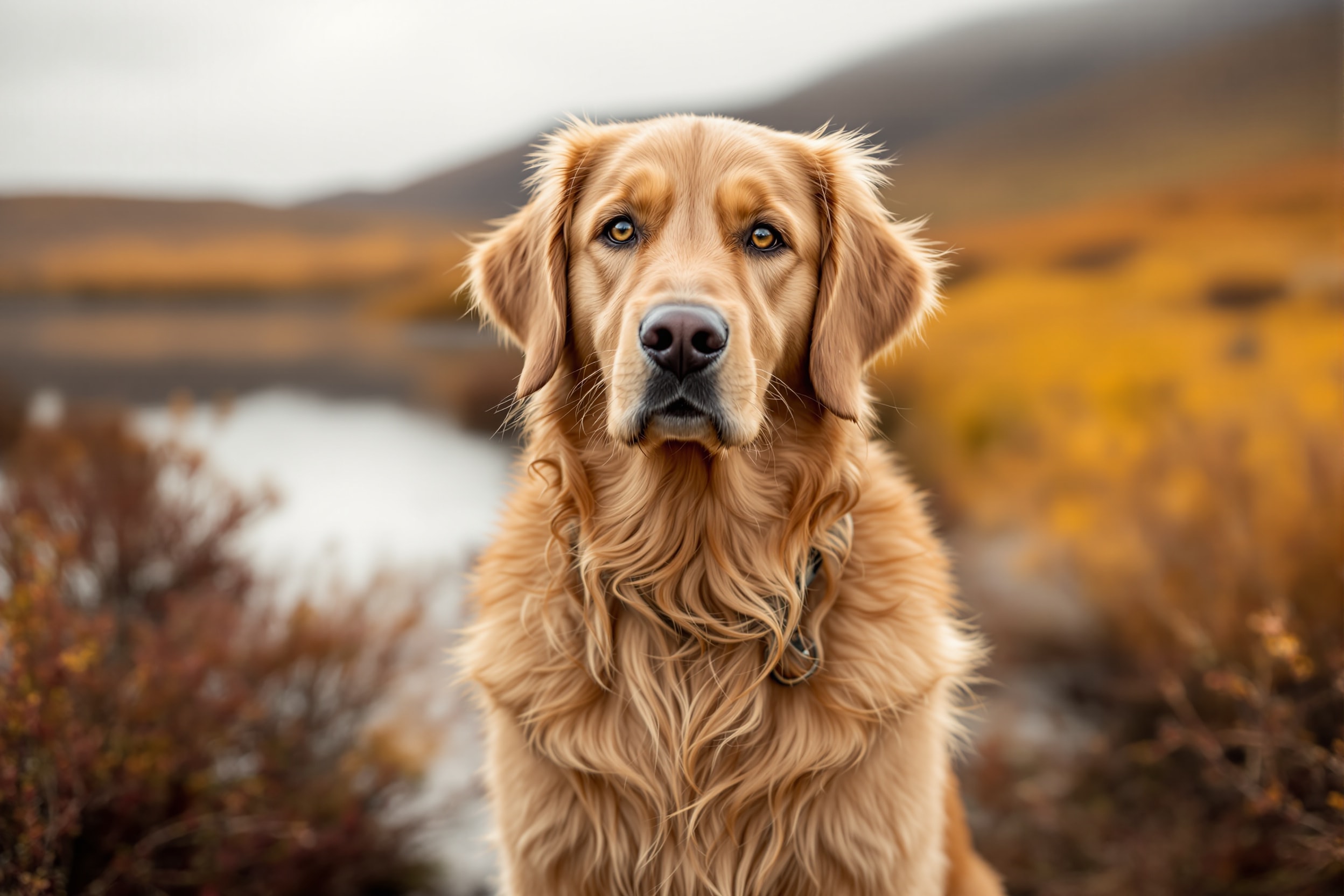
- Country
- Scotland
- Height
- 22-24 inches (56-61 cm) dogs; 20-22 inches (51-56 cm) bitches
- Weight
- 65-75 pounds (29-34 kg) dogs; 55-65 pounds (25-29 kg) bitches
- Coat
- Dense water-repellent double coat, flat or wavy, with feathering
- Colour
- Any shade of gold or cream; neither red nor mahogany
- Other Names
- Golden, Yellow Retriever (historical)
- Registry
- The Kennel Club (1913); AKC (Sporting, 1925); FCI Group 8
- Group
- Retriever / Gundog
One of a very small number of breeds whose origin can be traced to a specific estate, a specific decade and a specific pair of dogs — because the man responsible kept meticulous records.
Guisachan
The breed was created at a Highland estate in Inverness-shire in the second half of the nineteenth century by its owner, a Scottish peer and enthusiastic sportsman, whose stud books survive and were published in the 1950s. They settle a question that had previously been answered with folklore, including a persistent and entirely false story about Russian circus dogs.
The actual foundation, in 1868, was a mating between a yellow retriever named Nous — an unusual coloured pup from an otherwise black litter, acquired from a cobbler in Brighton — and a Tweed Water Spaniel named Belle. The Tweed Water Spaniel is now extinct, which makes those records the only real evidence of what went into the breed. Later crosses to other retrievers, an Irish Setter and a Bloodhound are recorded in the same books.
The purpose was practical: the estate offered wet, rough Highland shooting, and the requirement was a retriever that would work cold water and heavy cover all day and remain soft-mouthed and biddable.
Popularity and Its Cost
The breed was recognised by The Kennel Club in 1913 and by the American Kennel Club in 1925, and has been among the most popular breeds in the English-speaking world ever since.
That popularity is deserved and it has been costly. Enormous demand has drawn in a great deal of careless breeding, and the gap between a well-bred Golden from health-tested parents and a badly bred one is very wide indeed — in temperament, in soundness and in lifespan. This is a breed where the choice of breeder matters more than usual.
A working/show divergence also exists: field-bred lines tend to be lighter, darker and considerably more driven than the heavier, paler show type, and the two are close to different dogs in daily practice.
Character
The Golden's reputation is broadly accurate. It is friendly, eager to please, exceptionally trainable and tolerant — which is why the breed dominates assistance and therapy work alongside the Labrador.
Two honest qualifications. First, it is a gundog, with a gundog's energy and need for occupation; a Golden without adequate exercise and mental work becomes destructive and frequently overweight. Second, its friendliness makes it a poor guard dog, and its sociability means it does badly when left alone for long periods.
Puppies are boisterous and slow to mature, often remaining adolescent in behaviour well past two years.
Health
This section matters more than usual for this breed. Goldens have an elevated lifetime incidence of cancer — haemangiosarcoma and lymphoma in particular — which is the leading cause of death in the breed and the subject of a long-running prospective study, the Golden Retriever Lifetime Study run by the Morris Animal Foundation, which has followed thousands of dogs from puppyhood.
Other significant concerns are hip and elbow dysplasia, progressive retinal atrophy and other eye conditions, subvalvular aortic stenosis, hypothyroidism and a strong tendency to obesity. Responsible breeders screen hips, elbows, eyes and heart, and a buyer should ask to see the certificates rather than take assurances.
Typical lifespan is ten to twelve years. Weight control is the single most useful thing an owner can do — see exercise and the health guide.