Breeds of Dogs
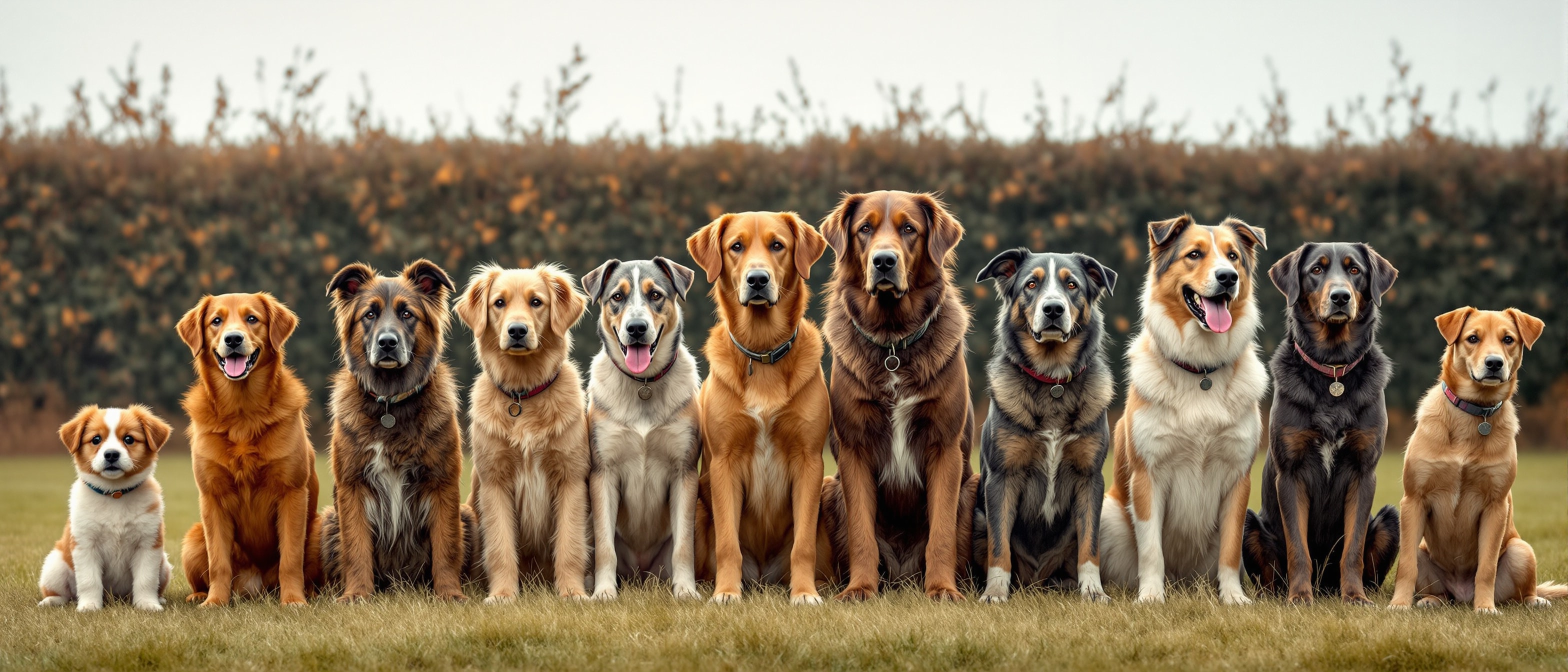
Although many animals have served people across the length of history, only one of them chose us. Only one was willing to leave its own kind and walk beside us instead. Every other working animal had to be captured, confined and broken to the task; the dog arrived at the fire on its own feet and stayed.
Archaeologists and cynologists keep pushing the date of that arrangement further back. Dogs lie in human graves. They appear in the earliest art. They served the hunter and the shepherd and the soldier, guarded the doorway, hauled the load, and walked the whole distance of a human life as a companion and nothing else. Whatever the exact millennium, the partnership is old enough that both species have been shaped by it.
Why So Many Breeds?
The question that gave this site its reason to exist is not how dogs came to live with us but why they came to look so wildly unlike one another. No other domestic species varies so far. A Chihuahua and an Irish Wolfhound are the same animal in the way a rowing boat and a container ship are both vessels.
The answer is almost always work. A breed is a record of a job, written in bone and coat and temperament by people who needed something done and had generations in which to get it. The Lundehund grew a sixth toe and a neck that folds backwards because someone needed a dog small enough to enter a cliff crevice and flexible enough to turn around inside it. The Bullmastiff is dark, silent and heavy because an English gamekeeper needed to find a poacher in the dark, knock him down and hold him there without killing him. The Galgo Espanol is built the way it is because the Spanish hare is fast.
Read enough breed histories and the pattern becomes hard to unsee. Terrain writes the leg length. Climate writes the coat. The quarry writes the temperament. The people write everything else.
The Rare and the Overlooked
Most dog references cover the same familiar hundred or so breeds thoroughly and then stop. This one was built the other way round. The Federation Cynologique Internationale currently recognises something close to 360 breeds and varieties, and national registries recognise many more that the FCI does not — to say nothing of landrace and working populations that no registry has ever touched.
Breeds unfamiliar in one country are often ordinary in another. A dog called "rare" in North America may be an unremarkable farm fixture in Morocco or Karelia or the Balearic Islands. The Chien de l'Atlas is not rare in the Atlas Mountains. The Perro de Presa Mallorquin is not exotic on Majorca. Rarity is usually just distance.
Some genuinely are scarce, and a handful have come within a few individuals of vanishing entirely. The Saarlooswolfhond exists because of one Dutchman's experiment in the 1930s. The New Guinea Singing Dog may be the least-changed dog on earth, and for fifty years was thought to survive only in captivity.
How to Use This Reference
Every breed entry opens with a data card — country of origin, size, coat, colour, alternative names, registry recognition and group — followed by the history of the breed and an honest account of what living with one is actually like. Where a breed carries a well-documented health concern or a legal restriction, the entry says so plainly. A reference work that flatters every breed is not a reference work.
- Browse the full alphabetical breeds list, or use the letter index at the top of every page.
- Read about the breed groups — how hounds, gundogs, terriers, working and herding dogs are classified, and why the systems disagree.
- New to dogs? Start with choosing the right breed and adopting a dog.
- Practical care lives under grooming, exercise and the health guide.
A Word on Sources
Breed history is a field thick with repeated folklore. Kennel-club origin stories are frequently romantic and occasionally invented outright, and a charming tale repeated for a century does not become true. Where the record is genuinely uncertain, these pages say it is uncertain. For registry standards and recognition dates the primary authorities are the American Kennel Club and the Federation Cynologique Internationale, whose breed nomenclature is the closest thing the world has to a common list.
Each breed, and each individual dog, matters to somebody. It serves a purpose, even where that purpose is only to make a house less quiet. That is reason enough to get the details right.