Lundehund
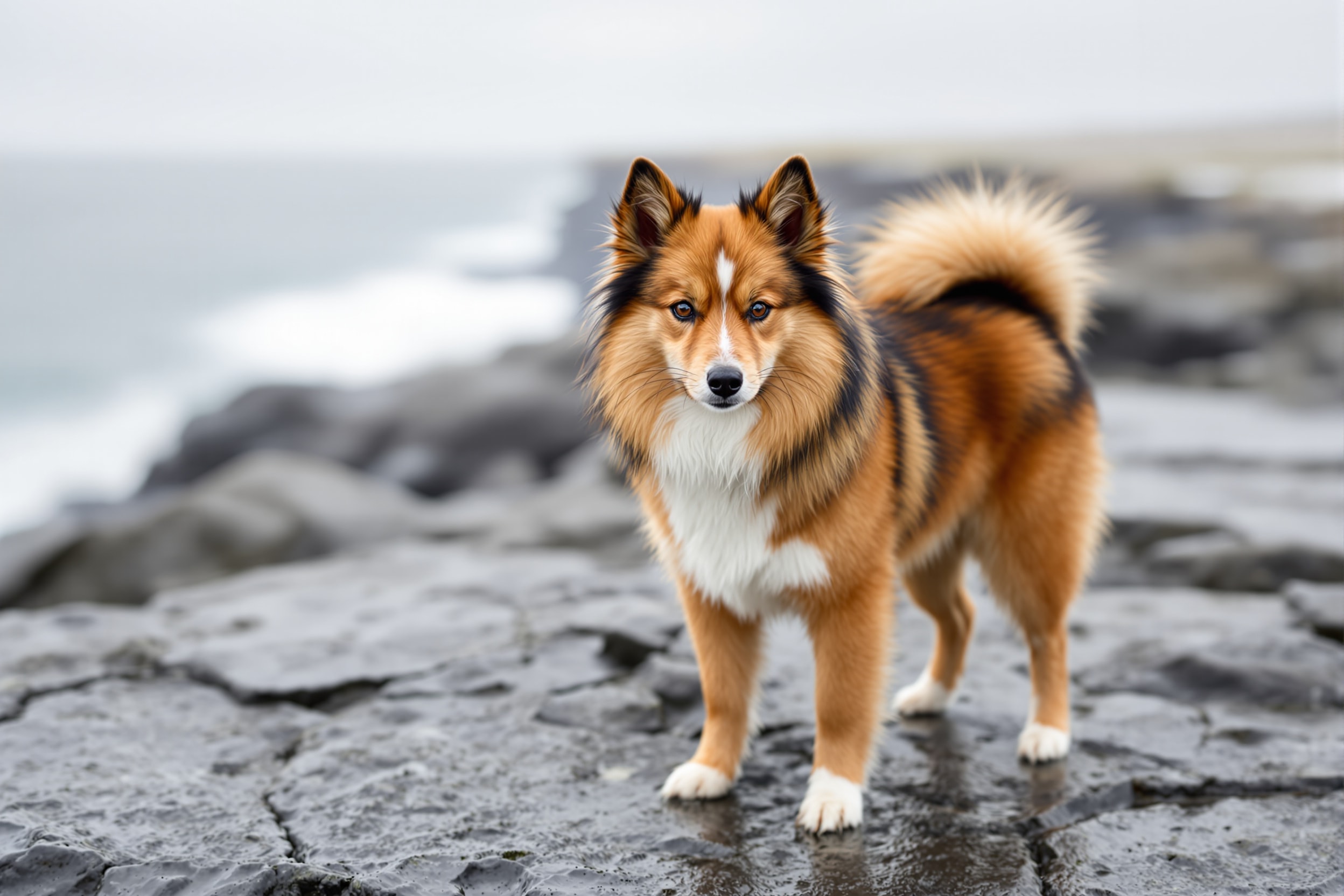
- Country
- Norway
- Height
- 12-15 inches (30-38 cm)
- Weight
- 13-15 pounds (6-7 kg)
- Coat
- Short, rough, stand-off double coat
- Colour
- Fallow to reddish brown with black tipping and white markings; black or white with black tipping also permitted
- Other Names
- Norsk Lundehund, Norwegian Puffin Dog, Norwegian Lundehund
- Registry
- FCI Group 5; AKC (Non-Sporting, 2011)
- Group
- Spitz and Primitive Types
No other dog is built like this one. The Lundehund is a small Nordic spitz with a set of anatomical modifications so specific, and so strange, that they read less like selective breeding than like a solution engineered backwards from a job description.
The Job
The job was puffins. On the exposed islands off Norway's Lofoten coast — Vaeroy and Rost above all — puffins nest in colonies deep inside the crevices and scree of near-vertical sea cliffs. For centuries the birds were an important food resource, salted and stored, and their down was worth money.
Harvesting them by hand was close to impossible. The nests sit at the end of narrow, twisting rock passages far beyond a human arm, on cliffs that offer no footing. What the islanders needed was a dog small enough to enter the passage, agile enough to climb the cliff to reach it, flexible enough to turn around inside a crack with no room to turn, and tough enough to take a puffin's beak and claws while doing it.
The Modifications
The Lundehund's adaptations are the most remarkable in the domestic dog:
- Six toes on every foot. Not a defect but a fixed breed characteristic — the standard requires them. Each front foot carries at least six fully formed toes with extra pads, giving grip on wet rock that a normal foot cannot manage.
- A neck that folds backwards. The Lundehund can bend its head back along its own spine until the skull touches the back, which allows it to reverse direction inside a passage too narrow to turn in.
- Shoulders that rotate outward. The forelegs can extend nearly perpendicular to the body, letting the dog flatten and spread itself against rock in a way closer to a lizard than a dog.
- Ears that close. The ear cartilage can fold forwards or backwards to seal the canal against water and grit dripping through the cliff.
Written down as a list it sounds fanciful. It is simply what the breed is.
History and Near-Extinction
The dogs were recorded on the Lofoten islands from at least the sixteenth century, and remained economically important until puffin harvesting was displaced by nets in the nineteenth century and finally by protective legislation. Once the job disappeared, the breed had no obvious reason to continue.
It then came close to ending twice. Distemper swept the islands around 1940 and again in the 1960s, and by the mid-1960s the entire world population had fallen to a handful of animals. Every Lundehund alive today descends from a founding group of roughly half a dozen dogs. The breed's recovery, driven by a small number of dedicated Norwegian breeders, is one of the genuine rescue stories in dog history — and it left the breed with one of the narrowest genetic bases of any recognised dog.
Health
That bottleneck has consequences and they should not be soft-pedalled. The breed carries a high incidence of a set of gastrointestinal disorders collectively called Lundehund syndrome, involving intestinal lymphangiectasia and protein-losing enteropathy — in plain terms, an inability to absorb protein properly from food. Severity varies from subclinical to fatal, and management usually involves lifelong dietary control under veterinary supervision.
Norwegian breeders have run a carefully supervised cross-breeding programme with related Nordic breeds specifically to widen the gene pool, one of the few such programmes attempted for a recognised breed. Anyone considering the breed should read the health material published by the American Kennel Club and speak to a breed club before anything else.
Character
Lundehunds are alert, energetic, affectionate with their own people and markedly reserved with strangers — a primitive breed's temperament, largely unsoftened. They are famously difficult to house-train, are accomplished escape artists, and retain a strong instinct to climb and to squeeze into places no dog should fit. They are also funny, clever and entirely without malice.
They are not a beginner's dog, and their numbers remain small. Related northern breeds are covered in the breeds list, and the wider spitz family is discussed under breed groups.