Jack Russell Terrier
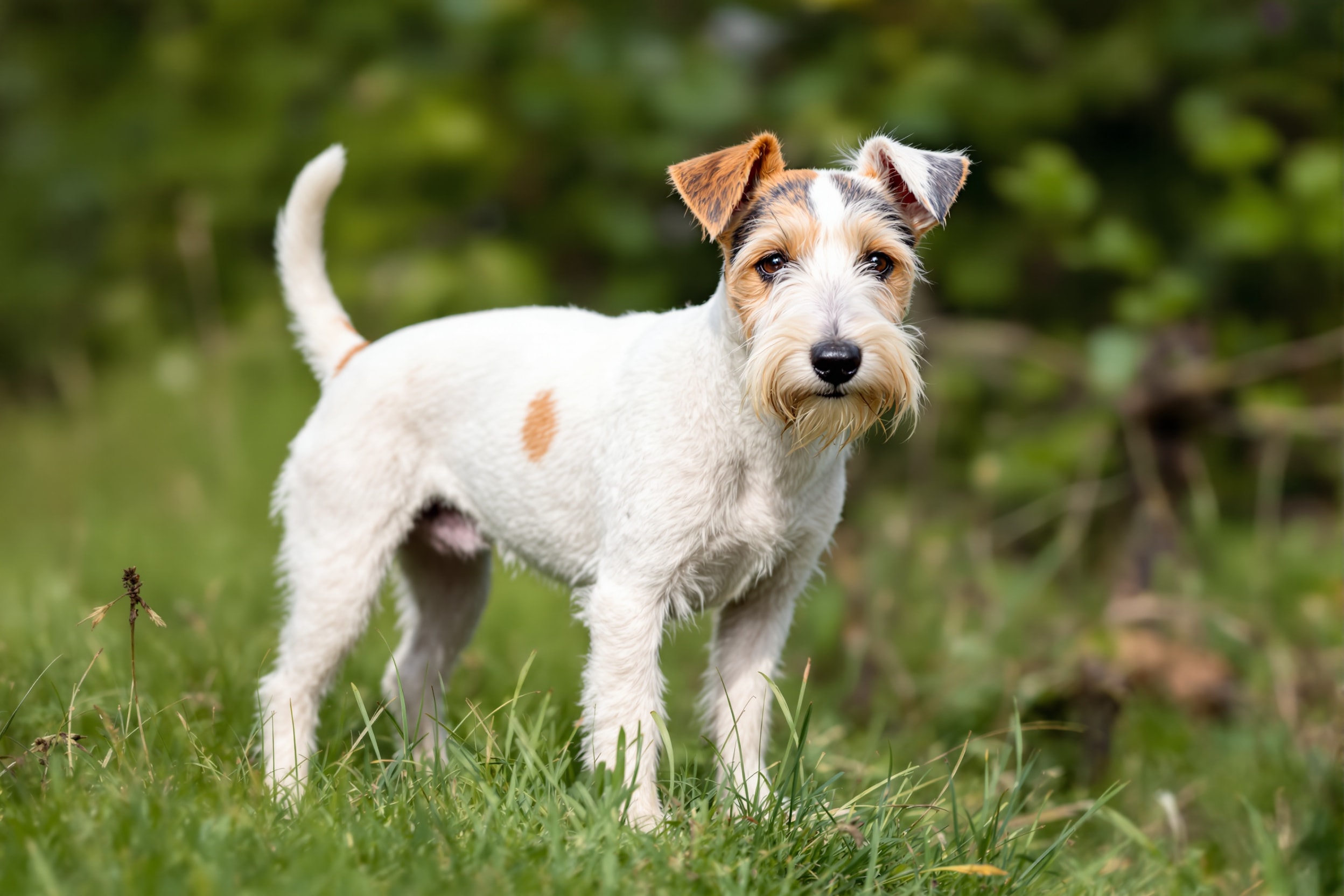
- Country
- England (Devon)
- Height
- 10-12 inches (25-30 cm)
- Weight
- 13-17 pounds (6-8 kg)
- Coat
- Smooth, broken or rough; all weatherproof and dense
- Colour
- Predominantly white with black, tan or tricolour markings
- Other Names
- Jack Russell, JRT
- Registry
- FCI Group 3 (as Jack Russell Terrier); AKC (Terrier, as Russell Terrier, 2012)
- Group
- Terrier
One of the most popular small dogs in the world, and one of the most consistently misunderstood. The Jack Russell is not a compact companion breed that happens to be lively. It is a working earth terrier, and everything difficult about it follows from that.
The Parson
The breed traces to a Devon clergyman, born in the 1790s, who was a keen and lifelong follower of hounds and who set about producing a terrier to a very specific working brief. The founding animal, acquired from a milkman during his student years, was a small white-bodied bitch of the type he wanted, and she became the foundation of the strain.
The brief was precise. The terrier had to be small enough to follow a fox to ground in a narrow earth, but long enough in the leg to keep up with mounted hounds across country in the first place. It had to be predominantly white, so that in poor light it could not be mistaken for the fox and injured by the hounds. And it had to be bold enough to face a cornered animal underground, alone, in the dark.
The last requirement is the one people forget when they buy a puppy.
Jack Russell, Parson Russell, Russell Terrier
The naming is a genuine muddle and worth untangling, because the three names refer to different dogs.
- Jack Russell Terrier — under the FCI standard, the shorter-legged, rectangular type, roughly 25-30 cm at the withers. Confusingly, the American Kennel Club registers this dog as the Russell Terrier.
- Parson Russell Terrier — the taller, squarer, longer-legged type, roughly 33-36 cm, recognised by the AKC in 1997 and closer to the original hunting specification for following horses.
- Working Jack Russells — a large population maintained by hunting people entirely outside the registry system, varying widely in type and registered, if at all, with working terrier clubs that have historically resisted show recognition on the grounds that it ruins the dog.
That last resistance is why the breed was recognised so late relative to its popularity, and it was a principled position rather than an eccentric one.
Character
Jack Russells are intelligent, fearless, extremely energetic and comprehensively unimpressed by their own size. They are affectionate and funny with their families and make excellent companions for the right household.
The honest cautions are substantial:
- Prey drive is very high. This is a dog bred to kill vermin underground. Small pets are at genuine risk, and recall around wildlife is a lifelong project.
- Digging and escaping are instincts, not misbehaviour. Fences need to go below ground.
- Energy demand is far beyond what the size suggests. An under-exercised, under-stimulated Jack Russell will find its own employment, and nobody enjoys the result.
- They can be scrappy with other dogs, particularly of the same sex, and early socialisation matters.
They are also long-lived — thirteen to sixteen years is normal — so this is a fifteen-year commitment to an animal that will still be busy at twelve.
Health
Generally a robust breed. Documented concerns include primary lens luxation and other hereditary eye conditions, patellar luxation, deafness (associated with the predominantly white coat), and Legg-Calve-Perthes disease. Responsible breeders test for the eye conditions, which have a known genetic basis in the breed.
Exercise requirements are discussed under exercise, and other working terriers appear in the breeds list.