Karelian Bear Laikas
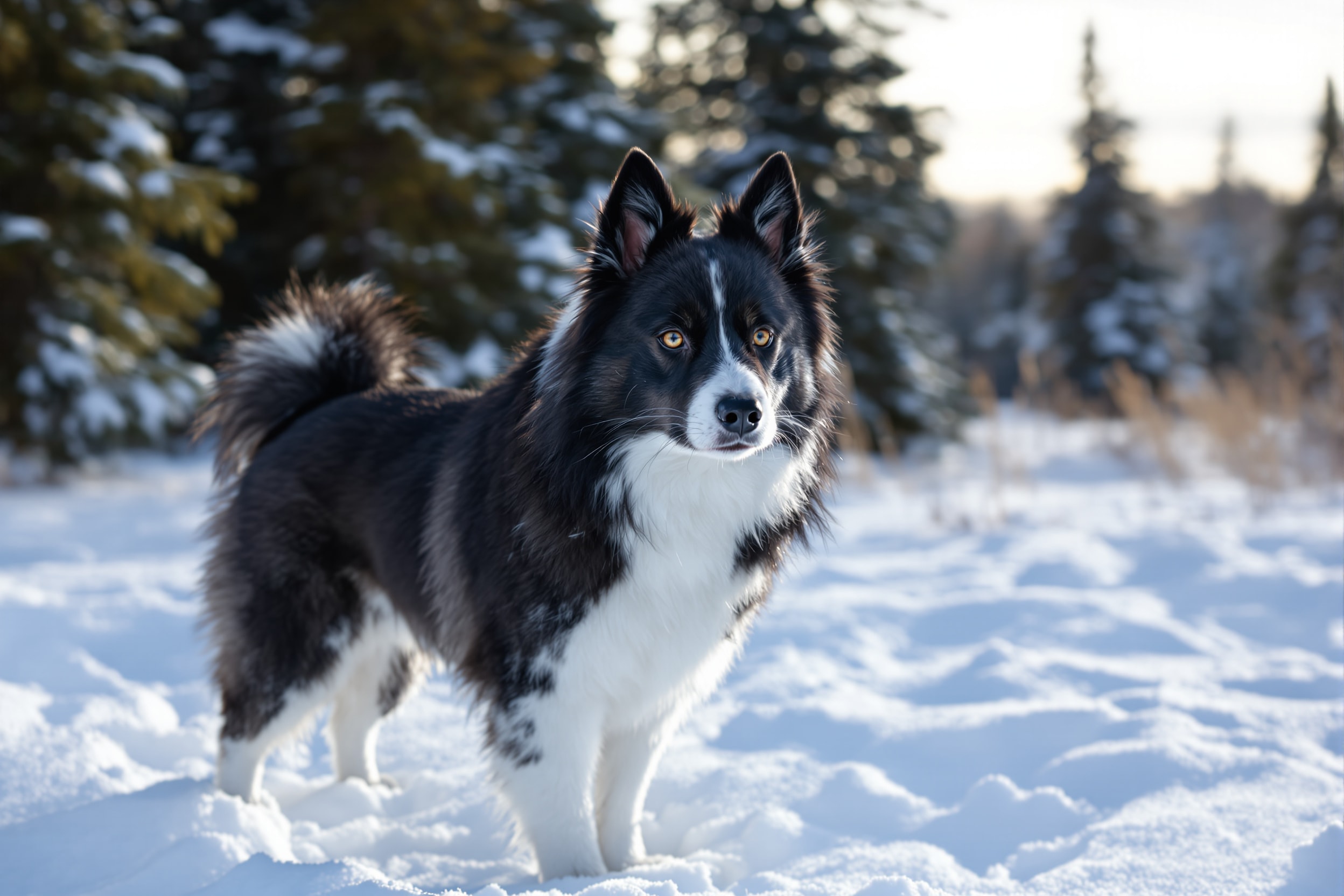
- Country
- Finland and Russian Karelia
- Height
- 19-23.5 inches (49-60 cm)
- Weight
- 44-63 pounds (20-28 kg)
- Coat
- Straight, harsh outer coat with a soft dense undercoat
- Colour
- Black, often with a brownish cast, with clearly defined white markings
- Other Names
- Karjalankarhukoira (Karelian Bear Dog); Russko-Evropeyskaya Laika (Russo-European Laika)
- Registry
- FCI Group 5 — Karelian Bear Dog no. 48, Russo-European Laika no. 304
- Group
- Spitz — Nordic Hunting Dogs
Two closely related black-and-white hunting spitz from either side of the Finnish-Russian border, developed from the same regional stock and separated by a frontier rather than by function.
Two Breeds, One Origin
The dogs of Karelia and the Lake Ladoga region were a single working population before the twentieth century drew a border through them. Finnish breeders formalised their side as the Karelian Bear Dog, recognised in 1945. Soviet breeders formalised theirs as the Russo-European Laika, recognised as a distinct breed in the 1940s and 1950s, with some Karelian stock in its foundation alongside other northern laikas.
The two remain very similar in appearance and temperament, both black and white, both bark-pointers. Where they differ, the Russo-European tends to be slightly lighter in build and more variable in the proportion of white.
The word laika comes from a Russian root meaning to bark, and that is the key to the whole type.
How a Bark-Pointer Works
These are not hounds that run game down and they are not gundogs that retrieve. A laika ranges independently, finds a large animal — bear, moose, boar — and then holds it in place by barking at it, moving constantly, staying out of reach, and keeping the animal's attention until the hunter arrives.
It is a job that requires exceptional courage, extremely quick reactions, and complete independence of judgement, since the dog is out of sight of its handler while doing the most dangerous part. The build follows: not large, but agile, tough, with a heavy weather-proof coat and reserves of stamina.
Modern Wildlife Work
The most interesting development in the breed's recent history has nothing to do with hunting. Karelian Bear Dogs have been adopted by wildlife agencies in North America and Scandinavia for non-lethal bear management — used to haze bears that have become habituated to people away from campsites, towns and roadsides.
The technique works because it applies the dog's natural behaviour to a conservation end: the bear is given a strongly unpleasant but harmless experience associated with human areas, and learns to avoid them. It has become an established tool in several US and Canadian jurisdictions, and it has spared a considerable number of bears that would otherwise have been destroyed.
Character
Karelians are intelligent, extremely independent, deeply loyal to their own people and highly reserved with strangers. They are dog-aggressive as a general rule, particularly with same-sex dogs, and their prey drive is not negotiable.
They are not suited to ordinary pet homes. They need a job, very substantial exercise, absolutely secure fencing, and an owner who understands that a dog bred to make its own decisions half a mile away will not deliver textbook obedience. In the right hands they are superb; in the wrong ones they are miserable and destructive.
Health
Both breeds are generally robust, having been selected almost entirely for working ability. Hip dysplasia and eye conditions occur at low rates, and Finnish breed clubs run screening programmes. The double coat needs regular brushing and moults heavily twice a year — see grooming.
The FCI maintains standards for both. Other Nordic hunting spitz — the Finnish Spitz, the Norwegian Elkhound, the Jamthund — appear in the breeds list.