New Guinea Singing Dog
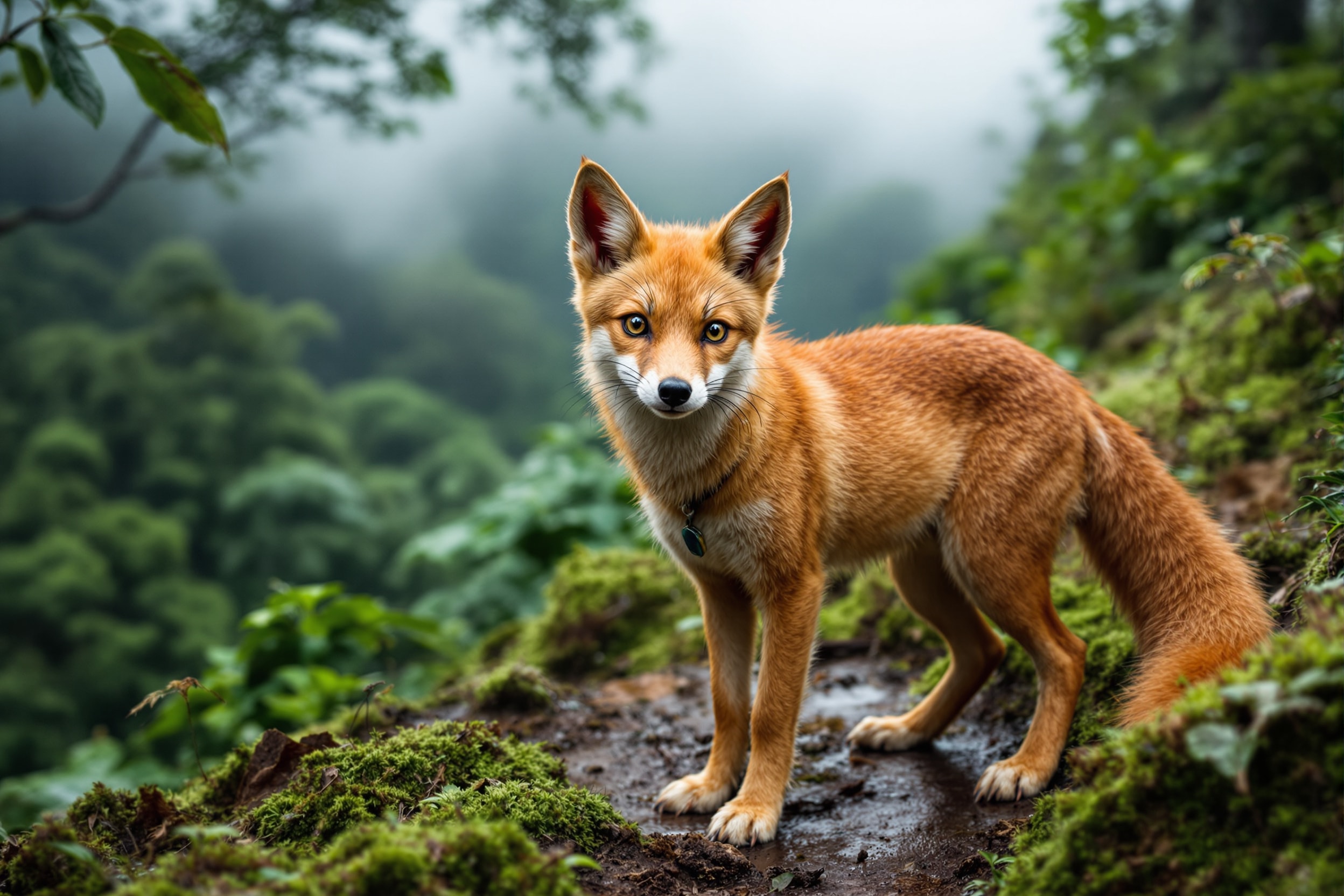
- Country
- New Guinea (highlands of Papua and Papua New Guinea)
- Height
- 14-18 inches (36-46 cm)
- Weight
- 20-30 pounds (9-14 kg)
- Coat
- Short, dense double coat
- Colour
- Ginger, red, black and tan, or cream; usually with white points
- Other Names
- Singer, NGSD, Hallstrom Dog, New Guinea Highland Wild Dog
- Registry
- No kennel club recognition; maintained as a conservation population
- Group
- Primitive / wild canid
Included here with a caveat: this is not really a breed. It is a wild or semi-wild canid population, closely related to the dingo, that happens to be maintained in captivity by a small conservation community — and it may be the least-altered dog on earth.
The Song
The name is literal and not a marketing flourish. The vocalisation that gives the animal its name is a long, modulated howl with a rising and falling pitch, quite unlike the howl of a wolf or a domestic dog. Individual notes sweep through a range of frequencies, producing overtones, and when several animals vocalise together they do not simply join in but appear to modulate against one another, producing a chorusing effect that observers have compared to whale song.
Recordings have been studied since the 1970s and the structure is genuinely distinctive. It is the single most reliable identifying characteristic of the population.
Origins and Status
Singing dogs belong to the same ancient group as the Australian Dingo, and both are thought to descend from early dogs carried into the region by human migration several thousand years ago, after which they lived largely independently of people. Their taxonomy has been argued about for decades — variously classified as Canis lupus dingo, Canis hallstromi, or as a subspecies or population of domestic dog — and the argument is not settled.
The captive population descends from a very small number of animals taken out of New Guinea between the 1950s and 1970s, and is consequently extremely inbred. For most of the late twentieth century it was widely assumed that no wild population survived, and that the captive animals were all that was left.
Rediscovery
That assumption turned out to be wrong. Field expeditions to the high-altitude regions of Papua, near the Grasberg mine area, photographed and later sampled wild highland dogs in 2016. Genetic analysis published subsequently found that these Highland Wild Dogs are the same population as the captive singing dogs, and that they retain substantially more genetic diversity.
This is the most significant thing to have happened to the animal in fifty years. It means the population is not extinct in the wild, and it opens the possibility of restoring diversity to a captive group that badly needs it.
Behaviour
Singing dogs are not pets and should not be treated as candidates for pet ownership. They are extraordinarily agile — able to climb and to jump in ways more reminiscent of a cat than a dog — with an exceptionally flexible spine, a very high prey drive, and a strong instinct to escape confinement. They are typically wary of unfamiliar people.
Captive animals are held almost entirely in zoos and by a small number of specialist conservation keepers under permit, and that is the appropriate arrangement. Anyone drawn to primitive breeds should look instead at recognised ones such as the Basenji or the Carolina Dog, both listed in the breeds list.
Conservation
The captive population's inbreeding is the central problem, with the associated risks of reduced fertility and immune function. The rediscovery of wild animals offers a possible route out, though any programme built on that would need to be managed with great care and with the involvement of Indonesian and Papua New Guinean authorities.
In the wild the animals face habitat pressure and hybridisation with village dogs. General background on primitive and spitz-type dogs is under breed groups.