Tosa Inu
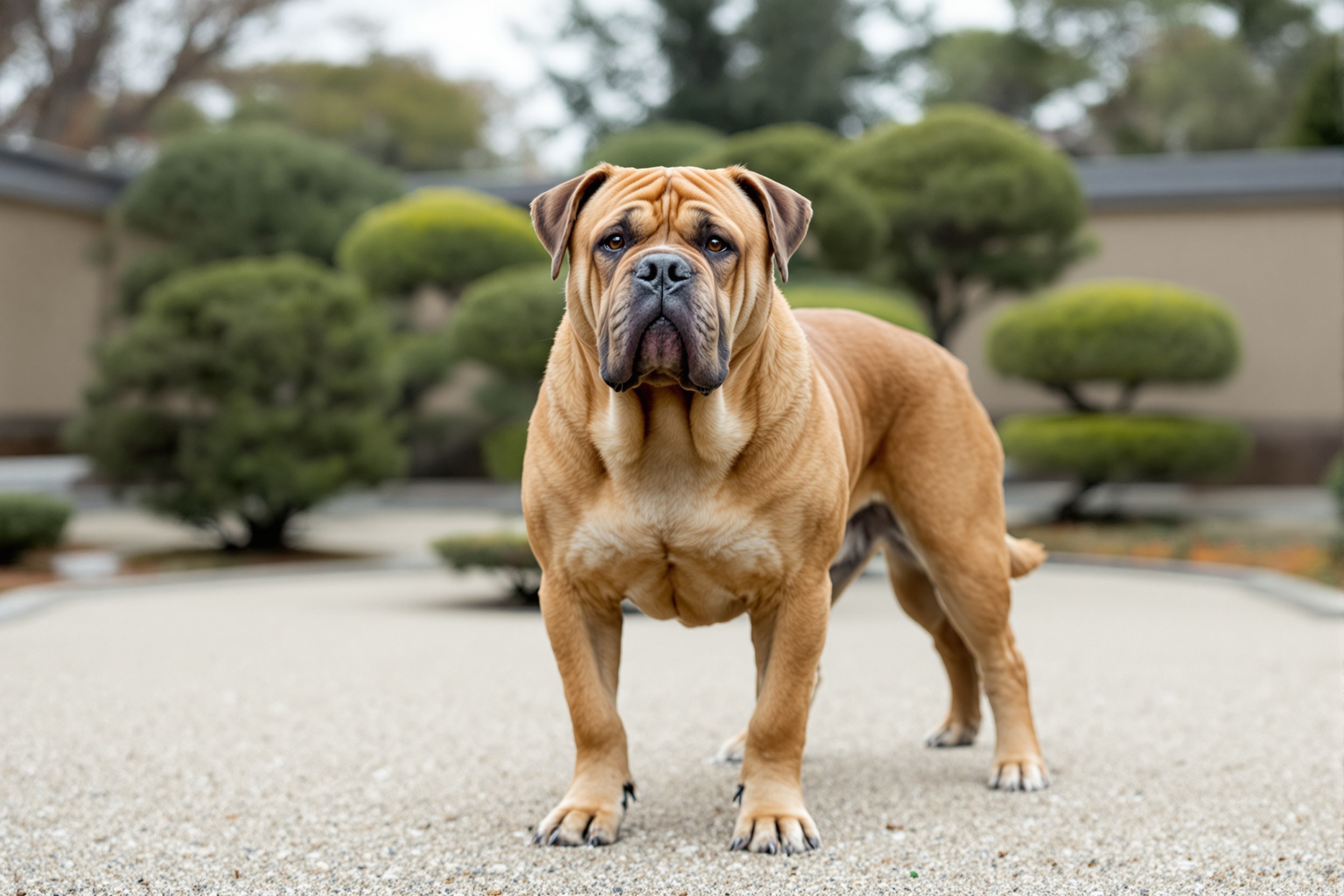
- Country
- Japan (Tosa Province, now Kochi Prefecture)
- Height
- 21.5-23.5 inches (55-60 cm) minimum; often considerably more
- Weight
- 80-200 pounds (36-90 kg); Japanese-bred dogs are typically far lighter than Western-bred
- Coat
- Short, hard and dense
- Colour
- Red, fawn, apricot, black or brindle; small white markings permitted
- Other Names
- Tosa Ken, Tosa Token, Japanese Mastiff
- Registry
- FCI Group 2; Nihon Ken Hozonkai; not AKC recognised
- Group
- Molossoid
The Tosa is the largest of the Japanese breeds and the only one built substantially from Western stock. It is also, in a number of countries, illegal to own — and any honest entry has to deal with both facts.
Origins in Tosa Province
The breed takes its name from the old province of Tosa on the island of Shikoku, now Kochi Prefecture. Its foundation was the native Shikoku-inu, a medium-sized regional spitz-type dog.
During the Meiji period, as Japan opened to the West, breeders in Tosa crossed the native dogs with a succession of imported European breeds — Mastiff, Great Dane, Bull Terrier, Bulldog, Pointer and Saint Bernard are all recorded in the programme, which ran across the second half of the nineteenth century and into the twentieth. The result was a dog dramatically larger than anything native to Japan, and quite unlike the other Nihon Ken breeds, which remain spitz-type and unmixed.
The Historical Purpose
The Tosa was developed for Japanese dog fighting, a formalised contest with roots going back centuries and its own elaborate ceremonial apparatus, including ranking titles borrowed from sumo. The breeding priorities that shaped the dog came directly from those rules: the contests demanded that a dog work in silence, without growling, barking or showing overt aggression signals, and dogs that vocalised were penalised.
This history is stated here because it is the reason the breed exists and because it explains its physical and behavioural type. It is not an endorsement. Dog fighting is a crime in most of the world, including throughout the United States and the United Kingdom, and it is a form of cruelty. Its persistence in a small number of places does not change that.
Legal Restrictions
Prospective owners must check the law before anything else. The Tosa is banned or severely restricted in a significant number of jurisdictions. In the United Kingdom it is one of four types prohibited under the Dangerous Dogs Act 1991, and it faces bans or restrictions in the Republic of Ireland, Denmark, Norway, Malta, Australia, New Zealand and elsewhere, with further restrictions at regional and municipal level in many countries that do not ban it nationally.
These are absolute legal prohibitions, not guidelines, and in banned jurisdictions they generally cannot be worked around by temperament testing or licensing. Anyone considering the breed should confirm the current position with their own national and local authorities — for the UK position, see the government's guidance on banned dogs.
Character
A well-bred Tosa in a competent home is described consistently as quiet, patient and undemonstrative — a notably calm dog that is reserved with strangers and strongly bonded to its household. The silence bred into it is real, and it makes the breed harder to read than a dog that telegraphs its intentions.
It is emphatically not a breed for an inexperienced owner. Its size, strength and low signalling threshold mean that early professional-quality socialisation, lifelong training and secure containment are baseline requirements rather than refinements. Japanese lines, bred to a smaller traditional standard, differ noticeably from the heavier Western-bred dogs.
Health
As a giant molosser the Tosa faces the predictable set: hip and elbow dysplasia, gastric dilatation-volvulus (bloat), cardiac conditions and heat sensitivity. Lifespan is typically ten to twelve years, better than several comparably sized breeds. General guidance is in the health guide; other molossers appear under breed groups.