Saarlooswolfhond
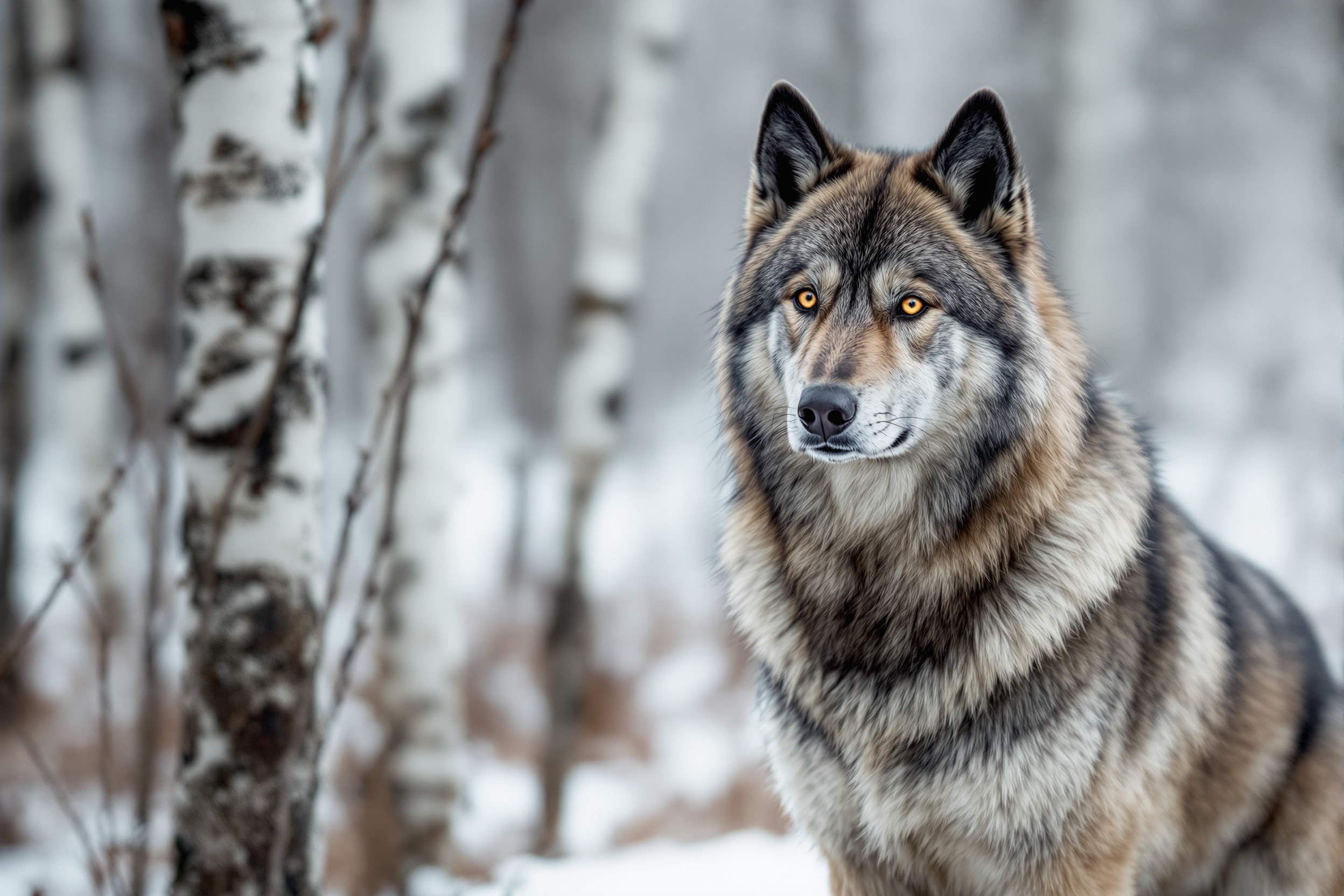
- Country
- Netherlands
- Height
- 26-30 inches (65-75 cm) dogs; 24-28 inches (60-70 cm) bitches
- Weight
- 79-90 pounds (36-41 kg)
- Coat
- Dense double coat, markedly heavier in winter
- Colour
- Wolf-grey, forest-brown or cream
- Other Names
- Saarloos Wolfdog, Saarloos Wolfhound
- Registry
- Raad van Beheer (1975); FCI Group 1, standard no. 311
- Group
- Sheepdog and Cattledog (FCI classification)
A deliberate twentieth-century experiment in putting wolf blood back into a domestic breed, undertaken with a clear goal — and remembered chiefly because it comprehensively failed to achieve it.
The Experiment
In 1935 a Dutch breeder began crossing a German Shepherd Dog with a female European wolf obtained from a zoo. His stated aim was to counteract what he saw as the softening and degeneration of the German Shepherd through show breeding, and to produce a hardier working dog with better natural resistance to disease.
He continued the programme for decades, backcrossing to German Shepherds and selecting carefully, and by his death in 1969 had produced a consistent and distinctive type. The Dutch Kennel Club recognised the breed in 1975, naming it after him, and the FCI followed.
Why It Did Not Work
The experiment succeeded physically and failed behaviourally, and the reason is instructive about domestication generally.
The dogs were indeed hardy, healthy and impressive. But what came across with the wolf genetics was not merely toughness — it was the wolf's caution. Saarlooswolfhonden proved shy, reserved and strongly inclined to avoid rather than confront anything unfamiliar. A programme intended to produce a more robust working dog had instead produced one whose first response to novelty was to withdraw.
An attempt in the Netherlands to train the breed as guide dogs for blind handlers was abandoned for exactly this reason. The dogs were intelligent and capable, but their reserve made them unsuitable for confident public work.
The lesson generalises: the tameness that makes a dog a dog is not a superficial layer over a wolf. It is deep, and it is precisely what is diluted when wolf blood is reintroduced.
Character
Modern Saarlooswolfhonden are described consistently by their own breed clubs as reserved, independent, powerfully pack-oriented and highly sensitive to their environment. They bond very strongly to their people and are typically excellent with their own family, including children.
They do not, however, behave like an ordinary dog. They avoid strangers rather than greet them. They are poor guard dogs, because their instinct is to retreat. They need extensive early socialisation, and they need company — a Saarloos left alone in a garden is a deeply unhappy animal. Recall is unreliable and off-lead freedom in unsecured space is generally unwise.
This is unambiguously a specialist's breed. Anyone attracted by the wolf-like appearance and expecting a German Shepherd's temperament will be disappointed, and so will the dog.
Legal Status
Because it has documented wolf ancestry, the Saarlooswolfhond is subject to restrictions in some jurisdictions that regulate wolf hybrids, even though it is a fully recognised breed many generations removed from the original cross. Local law should be checked before acquiring one. Its Czech counterpart, the Czechoslovakian Wolfdog, faces similar treatment.
Health
The breed is generally healthy, though the small founding population has left it with a narrow gene pool. Documented concerns include hip dysplasia, degenerative myelopathy and pituitary dwarfism, for which genetic tests exist. Lifespan is typically ten to twelve years.
The double coat sheds very heavily in spring and needs regular attention — see grooming. The FCI holds the standard. Other wolf-like breeds appear in the breeds list.